Download

R Thread vs T Thread Self-Drilling Anchor Bolts: Design, Load Capacity and Applications
Time:2026-06-13From:sinorock View:
R-thread and T-thread systems are the two most common self-drilling anchor bolt system thread profiles. Although both systems share the same basic installation principle, they differ significantly in thread geometry, load capacity, structural performance, and application range. Understanding these differences is essential for selecting the most suitable anchoring solution for a specific project. In this article, we compare R-thread and T-thread self-drilling anchor bolts in terms of design, performance, applications, and selection criteria.
R-thread self-drilling anchor bolts
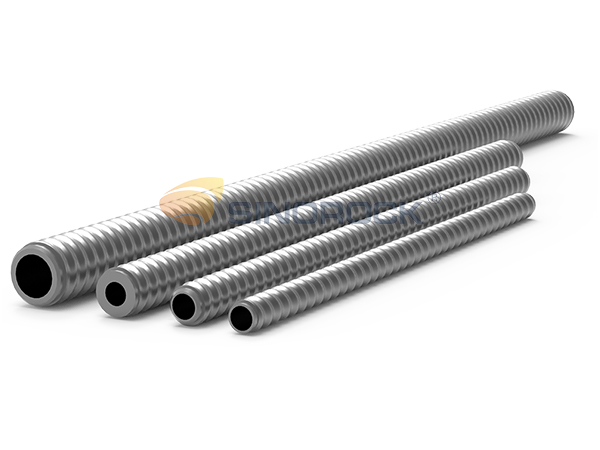
The R-thread system is primarily designed for light to medium anchoring loads. The R-thread profile is based on a rope-like continuous thread. Its main advantages are easy installation, reliable coupling, and suitability for conventional geotechnical support.
The system is widely used in soil nailing and slope stabilization projects. The available sizes range from R25 to R51. with ultimate loads ranging approximately from 200 kN to 925 kN.
For example:
· R25: Ultimate load 200 kN
· R32: Ultimate load 210–405 kN depending on wall thickness
· R38: Ultimate load 500–550 kN
· R51: Ultimate load 580–925 kN
T-thread self-drilling anchor bolts
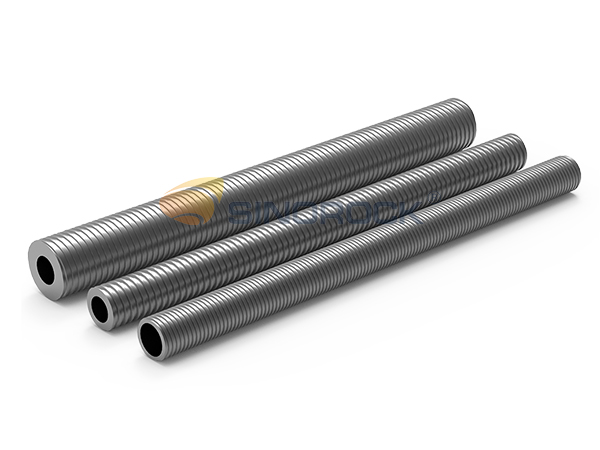
The T-thread profile has a larger thread pitch and deeper thread geometry, resulting in a stronger connection between the bar, coupler, nut, and accessories. The larger cross-sectional area also allows the manufacture of significantly larger diameters, such as T103. T111. T127. T130. T150. and T200. which are not available in the R-thread range.
The T-thread system covers a much wider range of heavy-duty applications. from T30 to T200. with ultimate loads ranging from 220 kN up to 14.230 kN.
Examples include:
· T30: 220–320 kN
· T40: 539–660 kN
· T52: 929 kN
· T76: 1.600–1.900 kN
· T103: 2.300–3.660 kN
· T130: 6.340–7.940 kN
· T200: 14.230 kN
This demonstrates that T-thread anchors are capable of carrying loads that are many times greater than those of the largest R-thread anchors.
Difference Between R Thread and T Thread
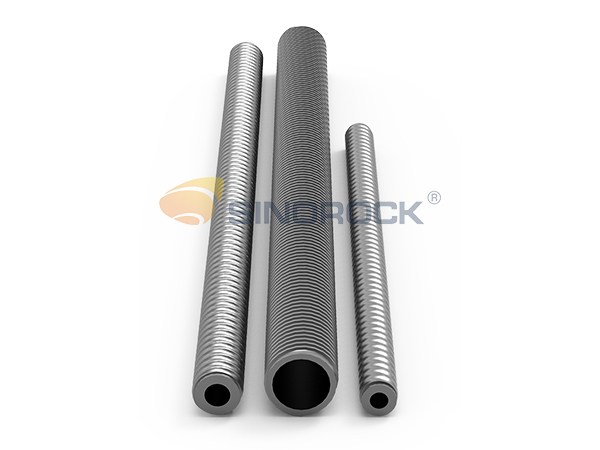
Let’s carefully explain the differences, covering design, performance, applications, and selection criteria for R-threads and T-threads in self-drilling anchor bolts.
Design Differences
R-threads' design is straightforward, sometimes called round or standard threads with a rounded crest. The thread profile of the R-thread hollow anchor bar conforms to ISO 10208. They're optimized for general-purpose bonding with grout. They rely primarily on friction between the bolt and the grout to transfer load.
T-threads have a distinctive T-shaped profile, the crest is flat, and the base flares outward. This shape increases the surface area in contact with grout, creating a mechanical interlock that strengthens the bond between the bolt and the surrounding rock or soil. Essentially, the T-thread is engineered to resist pullout and slippage, making it more suitable for challenging geological conditions or zones with high stress concentrations.
Performance Differences
R-thread bolts provide moderate pullout resistance and are suitable for standard rock support where loads are not extreme. They can be installed quickly and are effective in stable or lightly fractured rock.
T-thread bolts outperform R-thread bolts in almost every aspect of load-bearing. Their unique T-shaped profile distributes stress more evenly, enhances grout adhesion, and prevents slippage under high tension. This makes T-thread bolts ideal for deep tunnels, faulted zones, or weak and fractured rock where high-strength reinforcement is critical.
Application Differences
R-thread bolts are generally used for light to medium load applications. Typical scenarios include shallow tunnels, temporary support, or medium-load slope stabilization projects. Their load capacity is usually sufficient when the design load is below 1.000 kN.
T-thread bolts are preferred in high-demand applications such as deep underground mining, permanent tunnel support, catastrophic slope stabilization, or areas with fractured rock and fault zones. The availability of diameters up to T200 and capacities exceeding 14.000 kN makes the T-thread system suitable for structural applications where R-thread systems cannot meet design requirements.
How to Choose Between R-Thread and T-Thread?
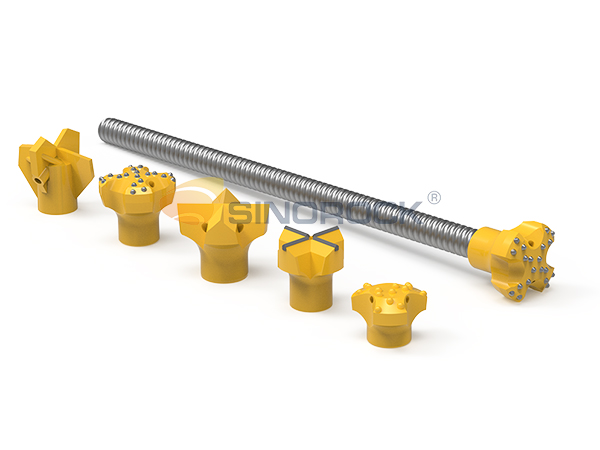
The selection should be based primarily on the required anchoring load and project type.
· Choose R-thread when simplicity, cost-effectiveness, and moderate load capacity are the priorities.
If the project involves tunnel support, mining reinforcement, soil nailing, or conventional slope stabilization with moderate loads, the R-thread system is generally the most economical and efficient choice.
· Choose T-thread when the project requires maximum load capacity, larger diameters, higher stiffness, and long-term structural performance.
If the project requires high load-bearing capacity, long-term structural support, foundation reinforcement, micropiling, or stabilization of large and critical structures, the T-thread system is usually preferred because of its greater strength, larger available diameters, and higher design capacity.
R-thread systems are primarily anchoring products, while T-thread systems can function as both anchoring and structural load-bearing elements, especially in micropile and foundation applications.
Conclusion
Both R-thread and T-thread self-drilling anchor bolts provide reliable ground support solutions, but they are designed to serve different engineering requirements. By carefully evaluating project loads, geological conditions, and long-term performance requirements, engineers can select the thread system that delivers the optimal balance of safety, efficiency, and cost-effectiveness.
latest news
-
- R Thread vs T Thread Self-Drilling Anchor Bolts: Design, Load Capacity and Applications
- Time:2026-06-13From:This Site
- Compare R-thread and T-thread self-drilling anchor bolts in terms of design, load capacity, performance, applications, and project selection criteria.
- View details
-
- How Self-Drilling Anchor Bolts Achieve Active Rock Reinforcement?
- Time:2026-06-09From:This Site
- Learn how self-drilling anchor bolts achieve active rock reinforcement through grouting and pre-tensioning to improve tunnel, mining, and slope stability.
- View details
-
- How Self-Drilling Anchor Bolts Drill and Grout Simultaneously
- Time:2026-05-25From:This Site
- Discover how self-drilling anchor bolts drill and grout simultaneously, improving efficiency, stability, and safety in geotechnical projects. Learn the mechanism, installation process, advantages, and common applications.
- View details
-
- Sinorock 2025 Quality Month | Strengthening Quality Foundations, Empowering Product Excellence
- Time:2025-08-13From:This Site
- Sinorock’s 2025 Quality Month, themed “Strengthening Quality Foundations, Empowering Product Excellence,” successfully concluded, reinforcing our commitment to superior product quality.
- View details
-
- Sinorock Safety Month 2025 | Everyone Speaks Safety, Everyone Can Respond
- Time:2025-07-03From:This Site
- Sinorock Safety Month 2025, centered on the theme "Everyone Speaks Safety, Everyone Can Respond - Spot Workplace Hazards," has wrapped up successfully!
- View details
-
- Quality Control: the Vital Factor of A SDA Bolt Factory
- Time:2025-01-09From:This Site
- Sinorock’s comprehensive quality control system, from supplier management to outgoing inspections, ensuring the highest standards for self-drilling anchor bolts in construction.
- View details
-
- SINOROCK Invites You to Mining Week Kazakhstan 2026
- Time:2026-06-08From:This Site
- Meet SINOROCK at Mining Week Kazakhstan 2026, Booth 925. Discover advanced self-drilling anchor systems and ground support solutions for underground mining, fractured ground, fault zones, and challenging geological conditions.
- View details
-
- Sinorock Invites You to Visit Us at CONEXPO-CON/AGG
- Time:2026-02-14From:This Site
- Sinorock Invites You to Explore Proven Self-Drilling Anchor Bolt Solutions at CONEXPO-CON/AGG –S63341.South Hall 1st Level
- View details
-
- SINOROCK to Showcase Innovative Mining Solutions at Mining and Metals Central Asia 2025
- Time:2025-09-09From:This Site
- We are pleased to share that SINOROCK will participate in the Mining and Metals Central Asia 2025, taking place from September 17 to 19 at the Atakent International Exhibition Centre in Almaty, Kazakhstan. You can find us at Booth 11-231.
- View details