Download

Application of Self-Drilling Anchor Bolts in Bridge Reinforcement
Time:2026-06-29From:sinorock View:
Self-Drilling Anchor Bolts (SDA) have been widely applied in bridge reinforcement projects in recent years. Compared to traditional anchor bolts, SDA bolts offer advantages such as simple installation, broad applicability, and shorter construction periods, making them especially suitable for bridge reinforcement projects in complex geological conditions. Their efficiency, safety, and cost-effectiveness have made them integral to bridge strengthening, repair, and reconstruction efforts.
1. Types of Bridge Reinforcement Applications
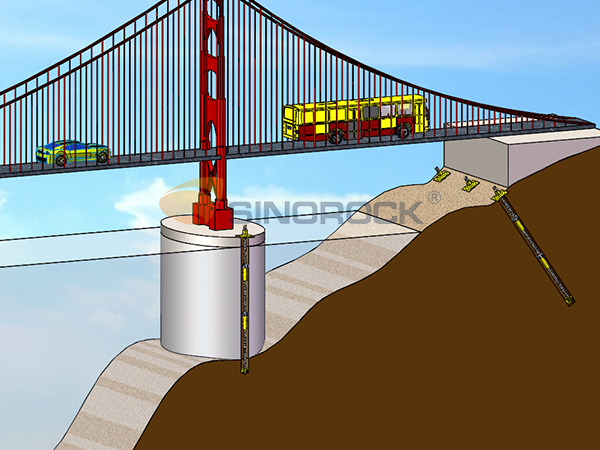
1.1 Reinforcement of Bridge Pier and Abutment Foundations
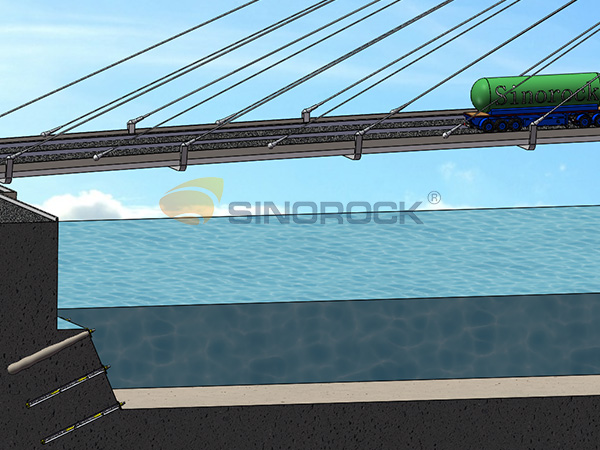
Anti-sliding and Anti-overturning: When the foundation of a bridge abutment or pier faces the risk of sliding or overturning due to lateral slope pressure, water erosion, or increased load, SDA bolts can be installed obliquely along the sides or bottom of the foundation. This anchors the structure to the deep, stable rock and soil layers beneath.
Foundation Strengthening: SDA bolts can be combined with grouting techniques to strengthen soft foundations beneath the bridge.
1.2 Reinforcement of Bridge Slopes
Slope Stabilization: For excavated or filled slopes on either side of the bridge approach, SDA bolts can help prevent landslides or collapses that could endanger the bridge abutments. They are often used in combination with mesh and shotcrete to create a reinforced anchoring framework.
1.3 Reinforcement of Bridge Superstructures (In Specific Cases)
Crack Reinforcement: In cases where structural cracks appear in bridge piers, caps, or beams, SDA bolts can be used for stitching or slant anchoring. Grouting can then be applied to seal the cracks, restoring the structural integrity.
Rebar and Connection: SDA bolts also serve as high-strength rebar, ensuring reliable connections between new components (such as enlarged foundations or added corbels) and the original structure.
1.4 Seismic Reinforcement of Bridges
SDA bolts can enhance the overall integrity and ductility of a bridge, restricting the concrete of piers and preventing brittle failure during earthquakes.
1.5 Temporary Support and Emergency Reinforcement
In cases of bridge foundation excavation, foundation pit support, or when a bridge experiences local instability due to disasters (e.g., water damage, impact), SDA bolts can quickly be deployed for temporary reinforcement.
2. Construction Process of Self-Drilling Anchor Bolts
Survey and Design: Based on bridge condition surveys and geological reports, the locations, depths, spacing, and angles for anchoring are determined, followed by specialized design.
Preparation: The site is cleared, work platforms are built, and layout lines are marked.
Drilling and Installation: Using specialized drilling machines, SDA bolts with drill heads are drilled to the design depth. During drilling, water or slurry can be injected through the hollow bolt to assist the drilling process.
Grouting: Once the hole is complete, a grout pump is connected to the bolt for high-strength cement or chemical grout injection. The grout pressure is carefully controlled to ensure full filling.
Installation of Bearing Plates and Nuts: After the grout reaches a certain strength, a steel bearing plate is installed at the bolt's end, and nuts are tightened to apply pre-stress (if required).
Tensioning and Locking (for prestressed anchor bolts): The anchor is tensioned to the design load using a hydraulic jack and locked in place, then sealed for protection.
3. Considerations During SDA Bolt Installation

Equipment Compatibility: Dedicated drilling machines and grouting equipment that match the specifications of SDA bolts are necessary.
Design Expertise: Design calculations (such as anchoring length and group anchoring effects) and construction parameters must be determined by experienced engineers.
Strata Limitations: Drilling efficiency may be lower in extremely hard or intact rock, requiring traditional drilling machines like percussion drills.
Durability: In corrosive environments, measures such as galvanized coatings, epoxy coatings, or full-length corrugated tube protection should be used to ensure long-term durability.
4. Advantages of Self-Drilling Anchor Bolts in Bridge Reinforcement
Bridge reinforcement projects often face challenges such as limited space, complex geology, the need for rapid construction, and minimizing damage to the existing structure. SDA bolts are well-suited to meet these requirements, offering the following advantages:
4.1 Adaptability to Geotechnical Conditions
Handling Broken Strata: In loose, fragmented, or weak rock and soil layers, or backfilled soil where traditional drilling methods face difficulties like hole collapse, SDA bolts provide a “drill and support” function that resolves these issues efficiently.
Crossing Complex Layers: SDA bolts can successfully pass through gravel layers, old concrete cracks, or other irregular obstacles.
4.2 High Anchor Strength
Complete Grouting: Full-column grouting ensures the grout fills all cracks in the drilled hole, tightly bonding with the bolt body and surrounding strata, providing high anchoring strength and minimal dispersion.
Continuous Threaded Bolts: The continuous threads along the length of the bolt provide excellent mechanical grip and shear force transfer capability.
4.3 Fast Construction
The process is integrated, saving time by eliminating the need for rod withdrawal and re-insertion. The construction speed is significantly faster compared to traditional methods, making SDA bolts ideal for emergency reinforcement projects and time-sensitive bridge works.
4.4 High Flexibility
SDA bolts can be extended to achieve deep anchoring (tens of meters deep), and can be installed in narrow, low-clearance bridge spaces or at inclined angles.
4.5 Minimal Disruption to Original Structure
Without the need for casing protection, the drilling diameter is relatively small, resulting in minimal disturbance to the existing bridge foundation and surrounding soil.
5. Conclusion
Self-Drilling Anchor Bolts, with their integrated “drill, anchor, and grout” technology, provide an efficient, reliable, and flexible solution for bridge reinforcement, particularly in foundation strengthening, slope stabilization, and emergency engineering in complex geological conditions. Representing a significant advancement in geotechnical anchoring technology, SDA bolts play an irreplaceable role in enhancing bridge safety and extending service life.
latest news
-
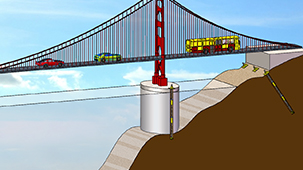
- Application of Self-Drilling Anchor Bolts in Bridge Reinforcement
- Time:2026-06-29From:This Site
- Discover how Self-Drilling Anchor Bolts (SDA) revolutionize bridge reinforcement projects. Learn about SDA applications in foundation strengthening, slope stabilization, seismic retrofitting, and construction processes.
- View details
-
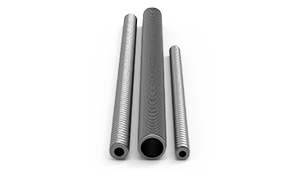
- R Thread vs T Thread Self-Drilling Anchor Bolts: Design, Load Capacity and Applications
- Time:2026-06-13From:This Site
- Compare R-thread and T-thread self-drilling anchor bolts in terms of design, load capacity, performance, applications, and project selection criteria.
- View details
-
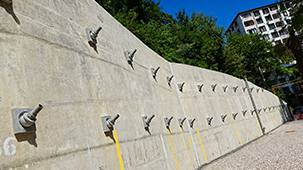
- How Self-Drilling Anchor Bolts Achieve Active Rock Reinforcement?
- Time:2026-06-09From:This Site
- Learn how self-drilling anchor bolts achieve active rock reinforcement through grouting and pre-tensioning to improve tunnel, mining, and slope stability.
- View details
-

- CBAM Policy Interpretation: Sinorock Promotes the Low-Carbon Transformation of Self Drilling Rock Bolts
- Time:2026-06-25From:This Site
- CBAM policy interpretation for self drilling rock bolts, covering carbon footprint requirements, EU compliance rules, and Sinorock’s low-carbon manufacturing strategy.
- View details
-
- Sinorock 2025 Quality Month | Strengthening Quality Foundations, Empowering Product Excellence
- Time:2025-08-13From:This Site
- Sinorock’s 2025 Quality Month, themed “Strengthening Quality Foundations, Empowering Product Excellence,” successfully concluded, reinforcing our commitment to superior product quality.
- View details
-
- Sinorock Safety Month 2025 | Everyone Speaks Safety, Everyone Can Respond
- Time:2025-07-03From:This Site
- Sinorock Safety Month 2025, centered on the theme "Everyone Speaks Safety, Everyone Can Respond - Spot Workplace Hazards," has wrapped up successfully!
- View details
-
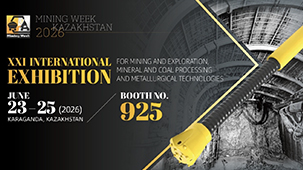
- SINOROCK Invites You to Mining Week Kazakhstan 2026
- Time:2026-06-08From:This Site
- Meet SINOROCK at Mining Week Kazakhstan 2026, Booth 925. Discover advanced self-drilling anchor systems and ground support solutions for underground mining, fractured ground, fault zones, and challenging geological conditions.
- View details
-
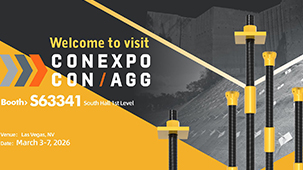
- Sinorock Invites You to Visit Us at CONEXPO-CON/AGG
- Time:2026-02-14From:This Site
- Sinorock Invites You to Explore Proven Self-Drilling Anchor Bolt Solutions at CONEXPO-CON/AGG –S63341.South Hall 1st Level
- View details
-
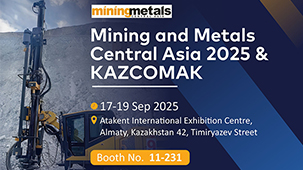
- SINOROCK to Showcase Innovative Mining Solutions at Mining and Metals Central Asia 2025
- Time:2025-09-09From:This Site
- We are pleased to share that SINOROCK will participate in the Mining and Metals Central Asia 2025, taking place from September 17 to 19 at the Atakent International Exhibition Centre in Almaty, Kazakhstan. You can find us at Booth 11-231.
- View details