Download

Self-Drilling Anchor Bolts and Protective Mesh: Active & Passive Support Systems Explained
Time:2025-12-11From:sinorock View:
In modern underground engineering and mining, support systems are crucial for ensuring safety. The combination of self-drilling anchor bolts (SDA) and protective mesh provides an efficient, cost-effective, and adaptable support solution. Based on their working principles, protective mesh can be classified into active protective mesh and passive protective mesh. These two types of mesh are used in different engineering projects, offering unique advantages when combined with self-drilling anchor bolts. This article will provide a detailed explanation of how self-drilling anchor bolts work with both types of protective mesh, the installation methods, applicable scenarios, benefits of the combination, and the overall performance of this integrated system.
1. Working Principles of Self-Drilling Anchor Bolts and Protective Mesh

Self-Drilling Anchor Bolts
Self-drilling anchor bolts are support devices that integrate both drilling and anchoring functions. They can be quickly drilled into rock or soil and provide stable anchorage. The principle of operation involves drilling into the ground using the built-in drill bit of the anchor bolt. Once installed, the bolt creates a secure anchorage by transferring external forces to the surrounding rock or soil through friction. Self-drilling anchor bolts are particularly efficient and effective in complex geological conditions, providing high tensile strength and rapid installation.
Active Protective Mesh
Active protective mesh works by using tensioned steel cables or wire mesh to constrain rock or soil, preventing movements such as sliding or falling debris. The primary principle is that the mesh material, supported by tensioned steel ropes, distributes external pressure and controls the deformation of rock or soil. Active protective mesh is typically used in areas with weak rock layers or unstable slopes. The system stabilizes the entire rock face or slope through the combined action of the mesh and anchor points.
Passive Protective Mesh
Passive protective mesh, unlike active mesh, does not rely on external tension. Instead, it works by utilizing the elasticity and resistance of the mesh to absorb and dissipate the forces from falling rocks or soil. The mesh provides a physical barrier, reducing the impact of rockfall or soil movement. Passive protective mesh is often used to prevent smaller-scale landslides or rockfalls. While it doesn’t actively control the deformation of the slope, it provides reliable protection by absorbing impact forces.
2. Self-Drilling Anchor Bolts Combined with Active Protective Mesh
Installation Method
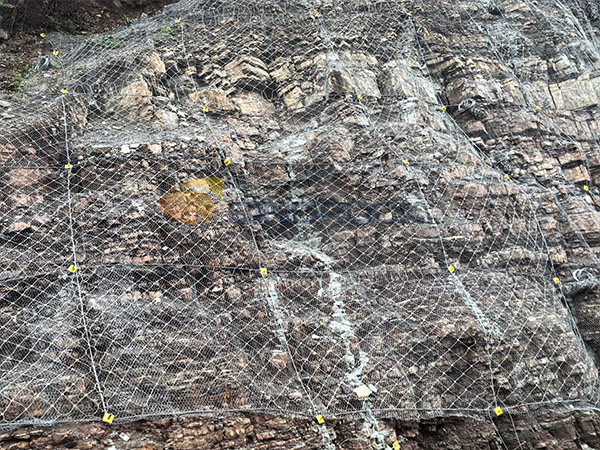
When self-drilling anchor bolts are combined with active protective mesh, the process begins by drilling holes into the rock face or slope. The length and diameter of the bolts are selected based on the geological conditions. The self-drilling anchor bolts are then quickly installed and secured in place. After that, the steel cables or mesh are connected to the bolts, and tension is applied to the mesh to ensure it is properly stretched and anchored. The tension applied to the mesh helps to reinforce the support system by spreading the forces across the entire slope or rock face. The combination of anchor bolts and tensioned mesh creates a robust, stable protective system.
Applicable Scenarios
The combination of self-drilling anchor bolts and active protective mesh is suitable for the following scenarios:
Weak rock formations or loose soils: These areas are prone to sliding or falling debris. The active mesh provides the necessary tension to stabilize the slope or rock face.
Steep slopes or mountainous regions: In high-angle areas, the active protective mesh distributes the pressure on the slope, preventing landslides or rockfall.
Areas prone to extreme weather events: Regions that experience heavy rainfall, snow, or earthquakes can benefit from the additional support provided by the active protective mesh, which enhances the overall stability of the slope or rock face.
3. Self-Drilling Anchor Bolts Combined with Passive Protective Mesh
Installation Method
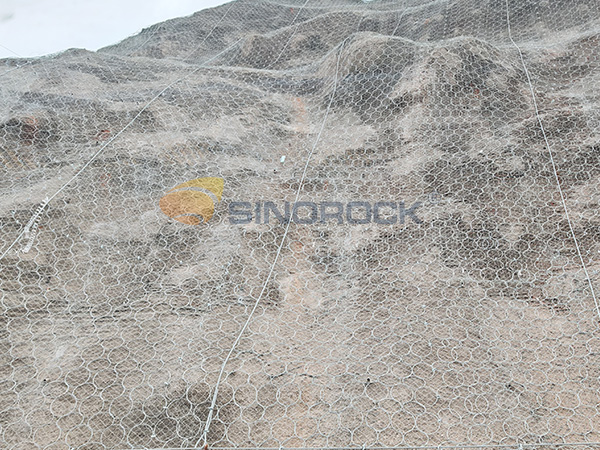
When self-drilling anchor bolts are combined with passive protective mesh, the installation method is similar to that used with active mesh. The bolts are drilled into the rock face or slope, providing a secure anchoring point. After the bolts are in place, the passive protective mesh is laid over the slope or rock face. Unlike active mesh, the passive mesh does not require tension to be applied. Instead, the mesh absorbs the forces from falling rocks or soil. The mesh is secured to the bolts to prevent it from shifting during impact. The overall system is designed to cushion and block the falling debris.
Applicable Scenarios
The combination of self-drilling anchor bolts and passive protective mesh is suitable for the following situations:
Low-angle slopes or more stable rock formations: These areas typically have less risk of large-scale landslides or falling debris, making passive mesh an effective, cost-efficient solution.
Simpler engineering environments: Projects that do not require the high load-bearing capacity of active mesh, such as small-scale mining or minor slope stabilization, can benefit from passive protective mesh.
Smaller-scale protection needs: Passive mesh is well-suited for protecting smaller areas from rockfall or soil displacement.
4. Advantages of Combining Self-Drilling Anchor Bolts with Protective Mesh
Improved Stability of the Support System
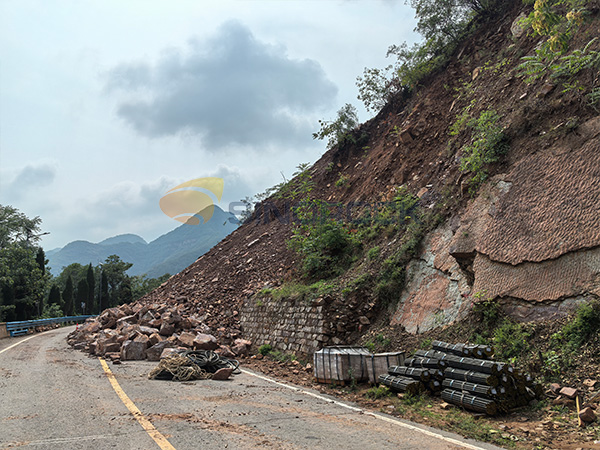
Whether using active or passive protective mesh, combining it with self-drilling anchor bolts significantly enhances the stability of the overall support system. The anchor bolts provide a strong, secure foundation, while the mesh adds further reinforcement.
Adaptability to Complex Geological Conditions
Self-drilling anchor bolts are highly effective in complex geological conditions. Whether in loose soils, fractured rock layers, or steep slopes, this system provides a versatile solution for challenging environments.
Enhanced Seismic and Landslide Resistance
The combined system of self-drilling anchor bolts and protective mesh can better distribute external forces, reducing the risk of landslides or rockfalls, especially in seismic or extreme weather conditions.
Faster Construction and Lower Costs
Compared to traditional support systems, the combination of self-drilling anchor bolts and protective mesh is quicker to install, leading to reduced construction times and lower costs. The simplicity of installation also minimizes the environmental impact, making it a sustainable solution.
5. Conclusion
The integration of self-drilling anchor bolts with both active and passive protective mesh provides a highly efficient and reliable support solution for a wide range of engineering projects. The combination enhances the stability of the support system and adapts to various geological environments. By choosing the appropriate type of protective mesh based on specific project requirements, the support system can ensure optimal performance, reduce construction time, and improve safety. Whether in mining, tunnel construction, or slope stabilization, the use of self-drilling anchor bolts with protective mesh offers a robust and effective method of ensuring long-term stability and safety for complex engineering projects.
latest news
-
- Mine Support and Stabilization Technology: Self-Drilling Anchor Bolt Systems
- Time:2026-04-23From:This Site
- Professional mine support solutions integrating drilling, pipe roof processes, and self-drilling anchors to ensure stable, safe, and efficient operations for both underground and open-pit mines.
- View details
-
- Self-Drilling Anchor Bolt Systems in Railway Tunnels: Applications and Standards
- Time:2026-04-21From:This Site
- Explore the applications and international standards of self-drilling anchor bolt systems in railway tunnels. Learn how they enhance slope, tunnel, and bridge stability for safer railway infrastructure.
- View details
-
- Self-Drilling Anchor Bolts for Micropiles: Complete Geotechnical Engineering Guide
- Time:2026-04-18From:This Site
- Explore the benefits of SDA bolt micropiles for constrained construction sites, complex geology, and rapid installation. Case studies and practical guidelines included.
- View details
-
- Sinorock 2025 Quality Month | Strengthening Quality Foundations, Empowering Product Excellence
- Time:2025-08-13From:This Site
- Sinorock’s 2025 Quality Month, themed “Strengthening Quality Foundations, Empowering Product Excellence,” successfully concluded, reinforcing our commitment to superior product quality.
- View details
-
- Sinorock Safety Month 2025 | Everyone Speaks Safety, Everyone Can Respond
- Time:2025-07-03From:This Site
- Sinorock Safety Month 2025, centered on the theme "Everyone Speaks Safety, Everyone Can Respond - Spot Workplace Hazards," has wrapped up successfully!
- View details
-
- Quality Control: the Vital Factor of A SDA Bolt Factory
- Time:2025-01-09From:This Site
- Sinorock’s comprehensive quality control system, from supplier management to outgoing inspections, ensuring the highest standards for self-drilling anchor bolts in construction.
- View details
-
- Sinorock Invites You to Visit Us at CONEXPO-CON/AGG
- Time:2026-02-14From:This Site
- Sinorock Invites You to Explore Proven Self-Drilling Anchor Bolt Solutions at CONEXPO-CON/AGG –S63341.South Hall 1st Level
- View details
-
- SINOROCK to Showcase Innovative Mining Solutions at Mining and Metals Central Asia 2025
- Time:2025-09-09From:This Site
- We are pleased to share that SINOROCK will participate in the Mining and Metals Central Asia 2025, taking place from September 17 to 19 at the Atakent International Exhibition Centre in Almaty, Kazakhstan. You can find us at Booth 11-231.
- View details
-
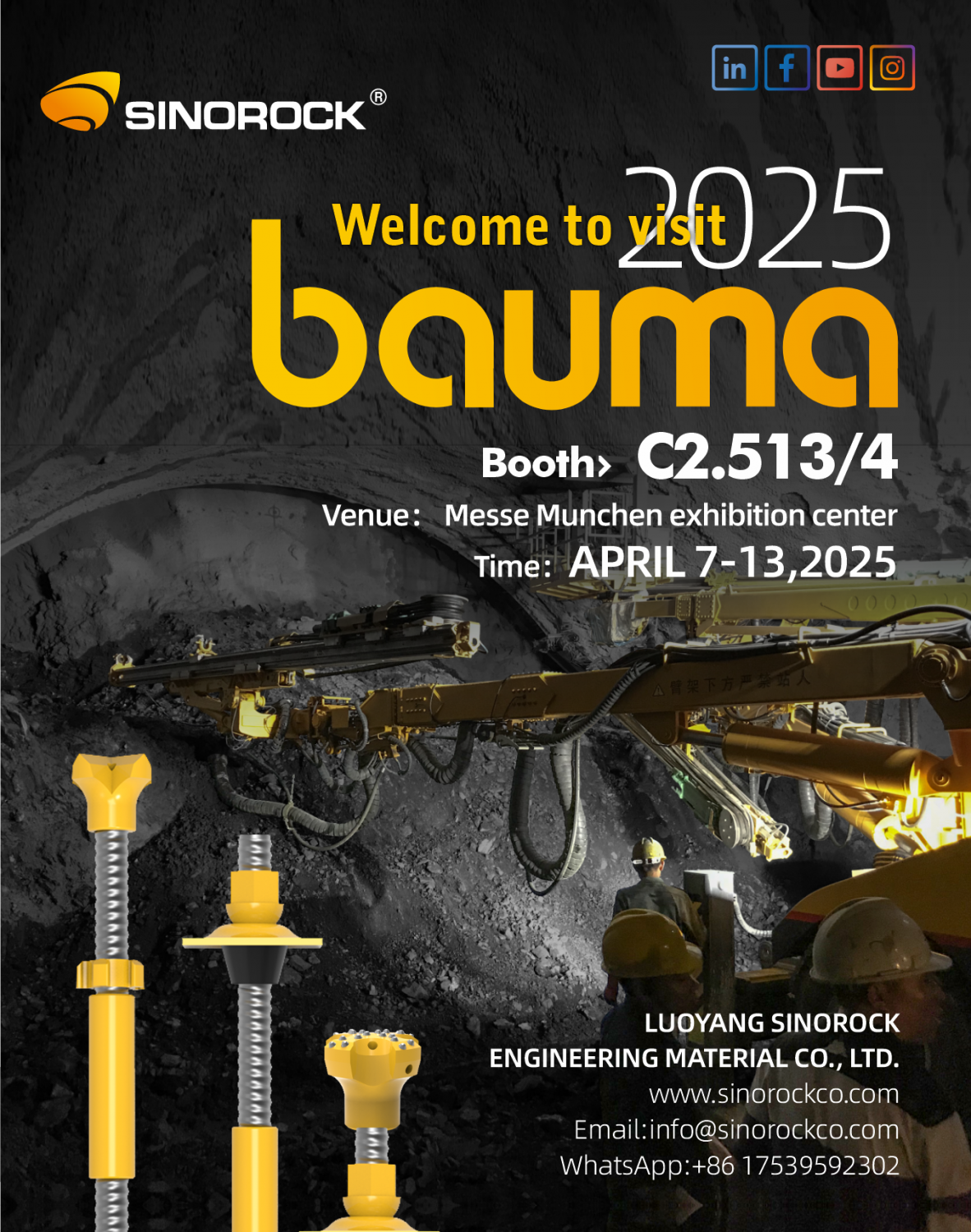
- Sinorock Invites You to Explore Proven Self-Drilling Anchor Bolt Solutions at bauma 2025
- Time:2025-03-07From:This Site
- From April 7–13, 2025, explore Sinorock’s Self-drilling anchor bolt solution at Booth C2.513/4 in Hall C2 of the Messe München Exhibition Center (Munich, Germany).
- View details