Download

Causes and Solutions for Tunnel Collapse: A Complete Guide to Self-Drilling Anchor Bolts
Time:2026-04-30From:sinorock View:
During tunnel construction, collapses caused by surrounding rock instability are among the most severe hazards threatening both construction safety and project progress. In geological conditions prone to collapse, traditional rock bolt support methods often encounter difficulties such as challenging drilling and anchoring failures. Self-drilling anchor bolts provide an effective solution for preventing collapses in fractured formations.
1. Causes of Tunnel Collapse
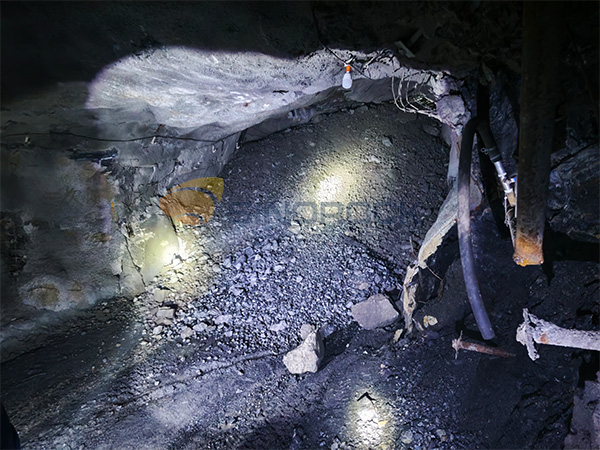
Tunnel collapses during support works are closely related to factors such as the geological characteristics of the surrounding rock, the intensity of construction disturbances, and groundwater activity. Anchoring measures should be specifically selected based on the type of collapse.
1.1 Collapse Due to Surrounding Rock Instability
This occurs when the rock mass is cut by internal structural planes (e.g., joints, fissures, faults, weak interlayers) or when the rock itself lacks sufficient strength. After excavation unloading, the surrounding rock cannot self-support, leading to block detachment, spalling, or overall collapse. Typical cases include fault fracture zones, layer-parallel collapses in stratified formations, and altered or weathered intrusive rock bodies.
1.2 Collapse Induced by Groundwater
Groundwater softens the surrounding rock, increases hydraulic pressure, and reduces the shear strength along structural planes, triggering sudden inflows or mud bursts that can destabilize the rock mass.
1.3 Collapse Triggered by Construction Disturbance
Improper excavation methods (e.g., unreasonable blasting parameters, excessive over-excavation), untimely or inadequate support (e.g., insufficient anchor length, spacing, or shotcrete thickness) can significantly amplify existing hazards, causing collapse.
In regions where the rock is heavily fractured, weathered, easily softened by water, or where drilling easily disturbs the original equilibrium, both anchoring quality and construction efficiency face severe challenges. In these fractured strata, using self-drilling anchor bolts mitigates drilling risks at the source, making them the preferred approach for reducing collapse probability.
2. Situations Suitable for Self-Drilling Anchor Bolts
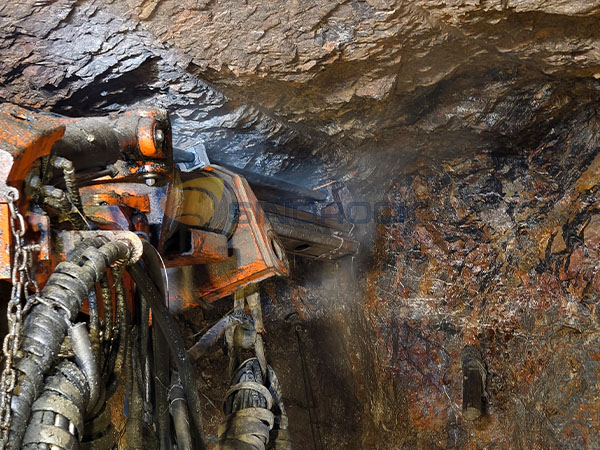
Self-drilling anchor bolts were specifically designed to address the “difficult drilling and anchoring” issues of traditional rock bolts in complex strata. Their hollow structure and integrated construction process offer irreplaceable advantages in the following scenarios:
2.1 Weak Surrounding Rock
In rock with developed joints and fissures, low integrity, and low strength, drilling itself disturbs the surrounding rock, often causing fragmentation that prevents traditional rock bolts from being installed. Self-drilling anchor bolts eliminate the risk of collapse during drilling by maintaining the anchor bar within the hole throughout the process.
2.2 Fault Fracture Zones
Rock masses in fault fracture zones are extremely discontinuous, making conventional drilling holes collapse. Self-drilling anchor bolts can drill directly into the rock without pre-drilling, rapidly providing support even in fractured conditions.
2.3 Loose Formations
Loose formations with low cohesion collapse during conventional drilling. Self-drilling anchor bolts inject grout during drilling, instantly filling voids and reinforcing the surrounding rock, ensuring effective anchoring.
2.4 Narrow Space Construction
Self-drilling anchor bolts require no large equipment, making them suitable for narrow spaces. Their fast and efficient installation also makes them ideal for emergency rescue in tunnel collapse scenarios.
3. Working Principle of Self-Drilling Anchor Bolts
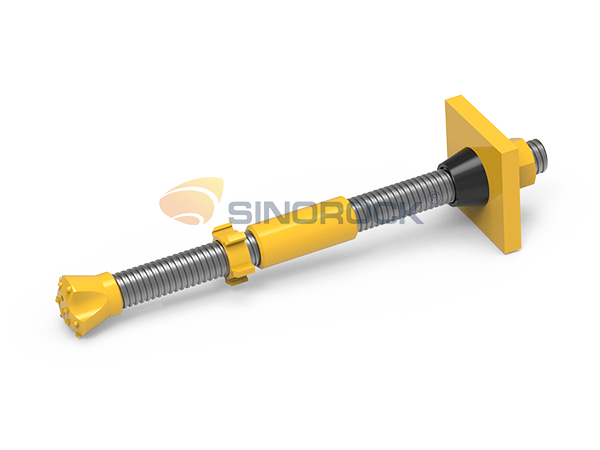
A self-drilling anchor bolt consists of a drill bit, hollow anchor bar, coupler, plug, plate, and nut. The hollow rod, made of thick-walled seamless steel with a standard threaded surface, serves both as a drill rod and a grout pipe. The drill bit is made of a high-hardness, wear-resistant alloy, with geometry influencing cutting efficiency and debris removal. The coupler allows a hollow anchor bar extension for varying depths.
The “self-drilling” function is achieved by the drill bit cutting action and the hollow rod serving as a debris channel. High-pressure water or air flushes rock cuttings out of the hole, maintaining cutting efficiency. Unlike traditional two-step methods (“drill first, insert anchor bar later”), the self-drilling anchor bolt integrates drilling and anchoring, eliminating hole wall exposure and preventing collapse at the source.
Once in place, grout is injected through the hollow rod, filling fractures and bonding loose blocks to form a high-strength whole. The grout also creates a high-adhesion medium between the rod and the hole wall, allowing the anchor bolt to quickly bear tensile and shear stresses and provide passive and active stabilization of the surrounding rock.
4. Construction Parameters of Self-Drilling Anchor Bolts
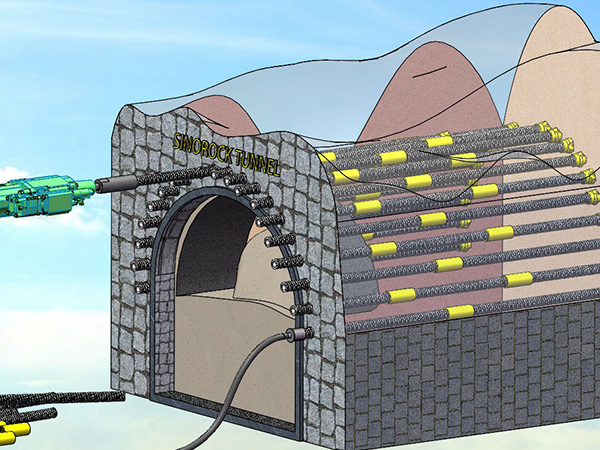
Key parameters, verified through extensive engineering practice, include:
4.1 Hollow Anchor Bar Type
Common specifications include R25. R32. R38. R51. T76. T103. R thread rods are standard threaded hollow self-drilling anchor bolts; T thread rods meet higher load and diameter requirements. Selection depends on the design anchoring force.
4.2 Anchor Length
Length depends on geological conditions and anchoring depth requirements, typically 1–6 m, with couplers allowing extension. In pre-support scenarios, the anchor bolt length should be coordinated with the lattice girder overlap requirements, with a typical longitudinal overlap length of ≥ 2 meters.
4.3 Spacing
Circumferential and longitudinal spacing should match rock type, tunnel dimensions, and required anchoring force, typically 30–40 cm circumferentially.
4.4 Grout Material
Use pure cement grout or 1:1 cement-sand grout, with a water-cement ratio of 0.4–0.5. Sand particle size ≤1.0 mm; high-performance grouts like pumpable resin technology can also be used.
4.5 Grout Pressure
Stepwise injection according to depth and section length, typically ≤1.0 MPa for one-time grouting; secondary high-pressure injection (≥1.6 MPa) may be used in deep or highly fractured rock.
4.6 Grout Strength
28-day compressive strength ≥30 MPa. Nuts are tightened only after grout reaches the specified strength (≥10 MPa) to achieve pre-stress locking.
5. Construction Method
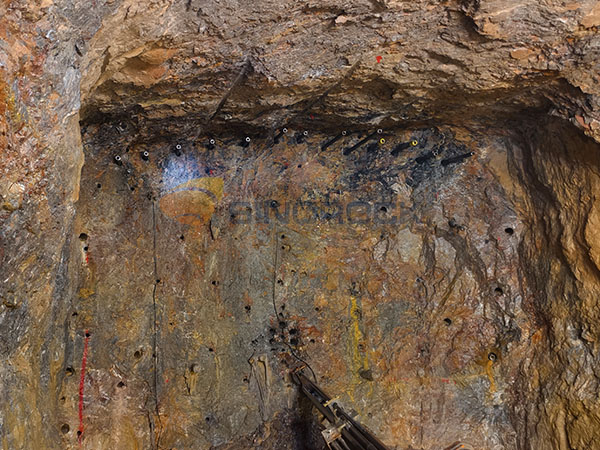
The construction process of self-drilling anchor bolts should be strictly carried out in accordance with industry standards and operation manuals. The following outlines the systematic construction steps and key quality control points:
Pre-Construction Checks: Verify designs, inspect rock bolts, drill bits, grouting materials, and ensure equipment functionality.
Marking and Measurement: Layout hole positions using instruments, marking with paint for precision.
Drill Rig Positioning: Align drill and anchor bar with hole axis.
Drilling and Hole Cleaning: Drill at low speed and torque, gradually increasing; flush to remove debris.
Anchor Extension: Use couplers for depths exceeding single rod length.
Grouting: Mix and inject grout through the hollow rod, maintain proper pressure, and perform secondary high-pressure grouting if needed.
Bearing Plate and Nut Installation: Position and preliminarily tighten plates and nuts.
Pre-Stress Locking: Final torque after grout achieves required strength, ensuring uniform axial load and active support.
Quality Acceptance: Verify anchoring via pull-out tests and non-destructive inspection and remediate any non-compliant rock bolts.
6. Conclusion
Preventing tunnel collapses is a comprehensive task in underground engineering, focusing on maintaining the self-supporting capacity of the surrounding rock through anchoring. In fault fracture zones, weak interlayers, and collapsed loose deposits, self-drilling anchor bolts outperform traditional grout anchors, effectively overcoming drilling collapse, insertion difficulties, and incomplete grouting, significantly enhancing support reliability and collapse prevention.
latest news
-
- Causes and Solutions for Tunnel Collapse: A Complete Guide to Self-Drilling Anchor Bolts
- Time:2026-04-30From:This Site
- Tunnel collapses caused by weak rock, groundwater, or construction disturbances can be prevented with self-drilling anchor bolts. Learn when, where, and how to use them effectively.
- View details
-
- Tunnel Pre-Support Methods: Techniques, Applications, and Comparisons
- Time:2026-04-24From:This Site
- Overview of tunnel pre-support methods, including pipe roofing, umbrella arch, grouting, forepoling, and ground freezing, with applications, comparisons, and construction strategies.
- View details
-
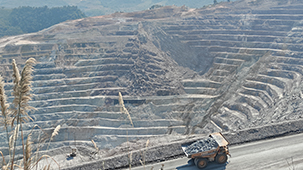
- Mine Support and Stabilization Technology: Self-Drilling Anchor Bolt Systems
- Time:2026-04-23From:This Site
- Professional mine support solutions integrating drilling, pipe roof processes, and self-drilling anchors to ensure stable, safe, and efficient operations for both underground and open-pit mines.
- View details
-
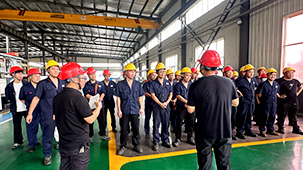
- Sinorock 2025 Quality Month | Strengthening Quality Foundations, Empowering Product Excellence
- Time:2025-08-13From:This Site
- Sinorock’s 2025 Quality Month, themed “Strengthening Quality Foundations, Empowering Product Excellence,” successfully concluded, reinforcing our commitment to superior product quality.
- View details
-
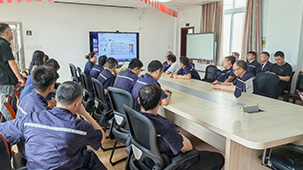
- Sinorock Safety Month 2025 | Everyone Speaks Safety, Everyone Can Respond
- Time:2025-07-03From:This Site
- Sinorock Safety Month 2025, centered on the theme "Everyone Speaks Safety, Everyone Can Respond - Spot Workplace Hazards," has wrapped up successfully!
- View details
-
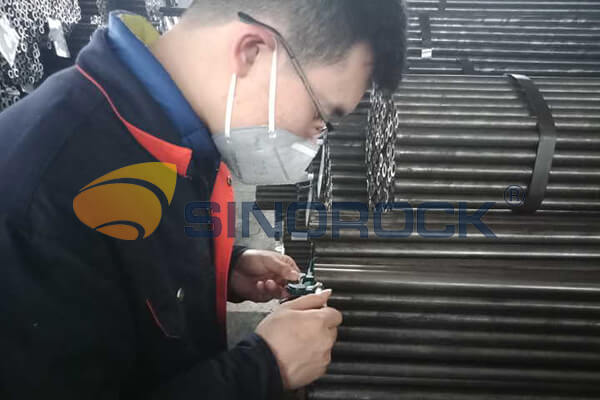
- Quality Control: the Vital Factor of A SDA Bolt Factory
- Time:2025-01-09From:This Site
- Sinorock’s comprehensive quality control system, from supplier management to outgoing inspections, ensuring the highest standards for self-drilling anchor bolts in construction.
- View details
-
- Sinorock Invites You to Visit Us at CONEXPO-CON/AGG
- Time:2026-02-14From:This Site
- Sinorock Invites You to Explore Proven Self-Drilling Anchor Bolt Solutions at CONEXPO-CON/AGG –S63341.South Hall 1st Level
- View details
-
- SINOROCK to Showcase Innovative Mining Solutions at Mining and Metals Central Asia 2025
- Time:2025-09-09From:This Site
- We are pleased to share that SINOROCK will participate in the Mining and Metals Central Asia 2025, taking place from September 17 to 19 at the Atakent International Exhibition Centre in Almaty, Kazakhstan. You can find us at Booth 11-231.
- View details
-
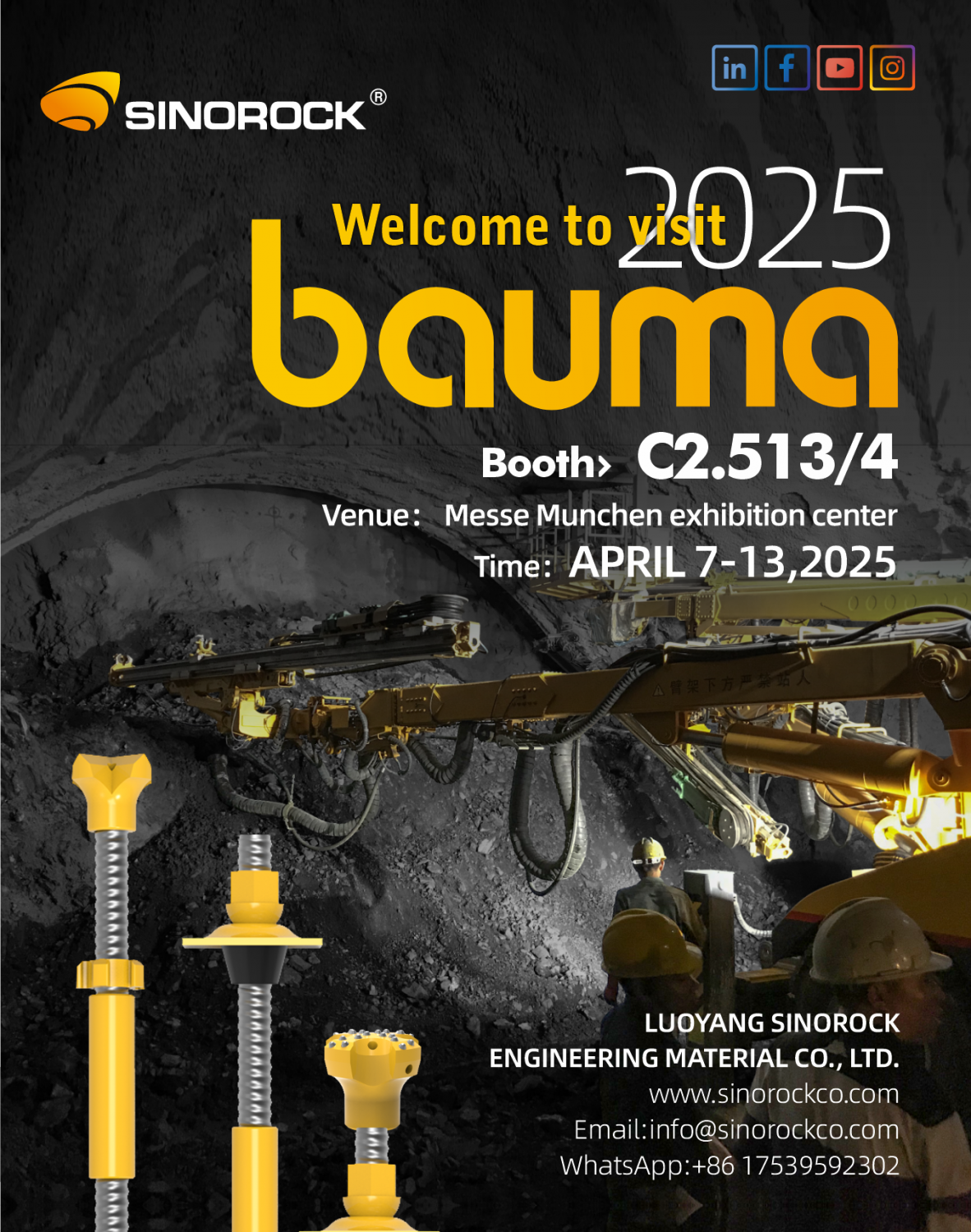
- Sinorock Invites You to Explore Proven Self-Drilling Anchor Bolt Solutions at bauma 2025
- Time:2025-03-07From:This Site
- From April 7–13, 2025, explore Sinorock’s Self-drilling anchor bolt solution at Booth C2.513/4 in Hall C2 of the Messe München Exhibition Center (Munich, Germany).
- View details