Download

Self-Drilling Anchor Bolts for Water-Conveyance Tunnel Reinforcement
Time:2026-07-27From:sinorock View:
Water-conveyance tunnels are critical components of hydropower and water supply projects, and their structural integrity directly affects long-term operational safety and downstream water security. However, during construction and operation, tunnels often encounter complex geological conditions, fluctuating water pressures, and surrounding rock deformation, which can lead to structural damage. Timely reinforcement is essential. This article systematically analyzes situations requiring tunnel reinforcement, principles for selecting anchor bolt support, anchor bolt types, and highlights the construction techniques and practical applications of self-drilling anchor bolts.
1. Situations Requiring Water-Conveyance Tunnel Reinforcement
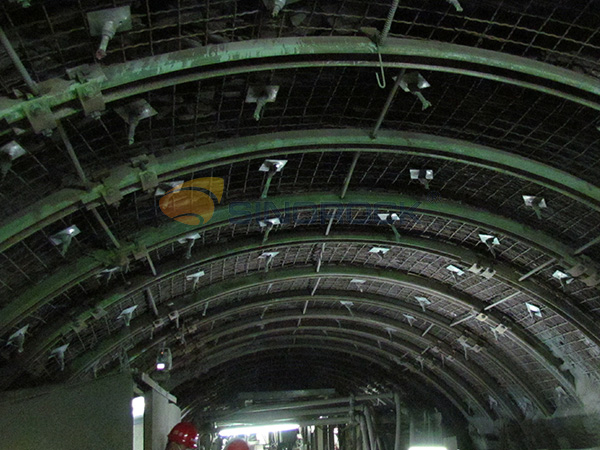
During construction and operation, tunnel linings and surrounding rock may suffer varying degrees of deterioration. Key situations requiring reinforcement include:
· Excessive Surrounding Rock Deformation: High-stress soft rock formations can deform significantly after excavation. Extremely soft rock (uniaxial compressive strength below 5 MPa) may cause lining cracks, rock block collapse, and surface subsidence. Without timely reinforcement, these deformations can threaten structural stability and construction safety.
· Cracking and Fracturing of Lining: Severe cracks often indicate geological weaknesses or voids between lining and surrounding rock, potentially accelerating water seepage and structural degradation.
· Tunnel Collapse: Collapses are among the most dangerous construction incidents. Loose debris flows at tunnel intersections cannot always be stabilized by conventional grouting, requiring specialized reinforcement.
· Weak or Fractured Rock Layers: Fault zones, karst formations, or weak interlayers are prone to local instability. Reinforcement with anchor bolts, shotcrete, and mesh may be required to maintain safety.
· Severe Water Infiltration: High-permeability, fractured rock may cause daily water inflows exceeding 2.000 m³, threatening tunnel durability.
· Durability Degradation During Operation: Continuous water flow can reduce mortar and concrete strength, while corrosive groundwater accelerates anchor and mesh deterioration, requiring timely reinforcement.
2. Selection of Reinforcement Methods
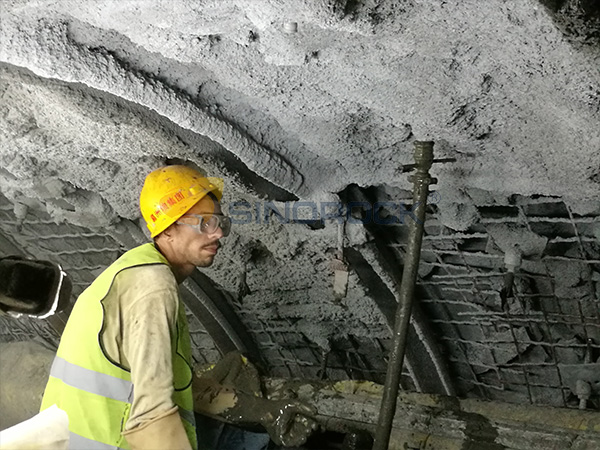
Reinforcement methods are selected based on surrounding rock type, deformation, geological conditions, and project requirements. Common techniques include anchor bolts, shotcrete with mesh, lining reinforcement, and grouting.
· Anchor Bolt Support: Anchor bolts stabilize fractured rock by connecting unstable rock to deeper, stable layers. Pre-stressed anchor bolts can actively control deformation and improve rock strength and stiffness.
· Shotcrete and Mesh: Shotcrete protects the rock surface and, combined with anchor bolts, forms an integrated support system, especially effective for weak rock classes (IV-V).
· Lining Reinforcement: Cast-in-place reinforced concrete linings restore structural integrity in damaged sections and can incorporate drainage to manage water infiltration.
· Grouting: Cement grouting fills voids in poor-quality geological sections or karst formations, improving overall rock stability.
Anchor bolts are essential when surrounding rock is fractured with low self-supporting capacity, when active deformation control is needed, in loose debris flows where conventional grouting fails, in water-bearing fractured rock prone to collapse, and when seismic resistance must be enhanced.
3. Anchor Bolt Types
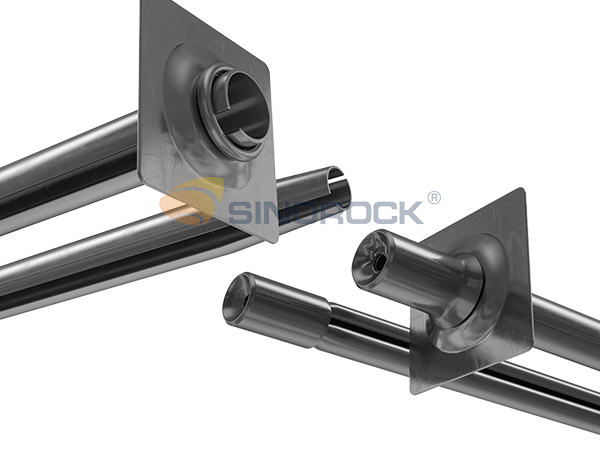
Anchor bolt types depend on geological conditions and reinforcement needs:
· Conventional Grouted Anchor Bolt: Suitable for stable rock with easy drilling; provides support after grout hardens.
· Pre-Stressed Anchor Bolt: Actively controls deformation; suitable for moderate or large deformation zones.
· Hydraulic Expansion Anchor Bolt: Provides rapid temporary support; typically not used for permanent reinforcement.
· Self-Drilling Anchor Bolt: Integrates drilling, grouting, and anchoring; ideal for fractured rock, weak interlayers, loose debris, and water-bearing formations. Self-drilling anchor bolts are available in diameters from 22 mm to 200 mm (R25-R51. T30-T200). R-type threads are for fast drilling; T-type threads are for higher load-bearing applications. Drill heads are selected based on rock type.
4. Construction Method of Self-Drilling Anchor Bolts
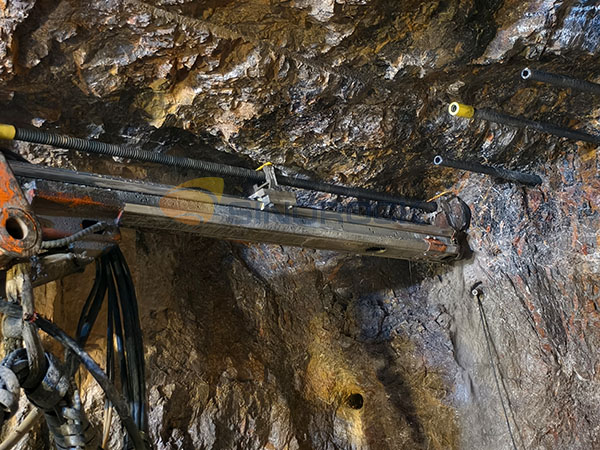
Self-drilling anchor bolt installation includes:
· Preparation and Inspection: Ensure water channels and drill holes are clear; verify drill alignment.
· Drilling and Hole Cleaning: Drill to design depth using the bolt as the drill rod; flush with water and air to remove debris.
· Bolt Fixing and Grouting: Install plates and nuts, then grout through hollow bolts under controlled pressure to fill fractures completely.
· Post-Tensioning: Tighten nuts after grout strength is sufficient, ensuring uniform load transfer.
· Quality Control: Check hole depth, grout flow, and perform pull-out or non-destructive testing to verify effectiveness.
5. Case Studies
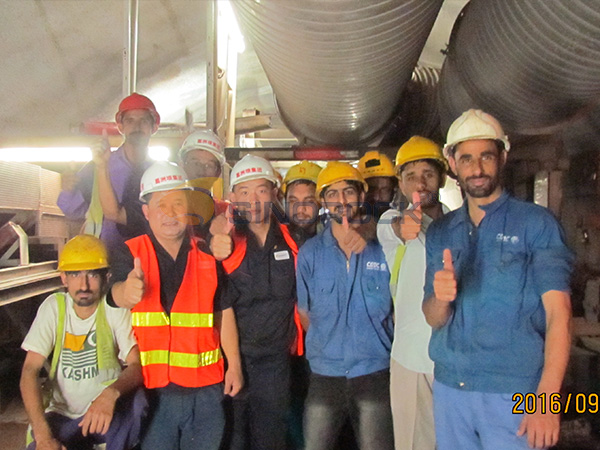
Tarbela Hydropower Station, Pakistan
As the largest hydropower project in Pakistan, the foundation slopes of the Tarbela station consist of highly weathered and fractured rock layers, including boulders, gravel, alluvial soil, and loose sand. Conventional drilling often faced jamming problems, affecting borehole quality. After detailed geological and site analysis, R32 self-drilling hollow anchor bolts were chosen for effective support. The 8-meter-long anchors, equipped with R32/76 cross steel drill heads, used 72mm centralizers to ensure grout thickness ≥20 mm. The self-drilling hollow anchors integrated drilling, grouting, and reinforcement, unaffected by collapsing strata. The simultaneous drilling and grouting method allowed one-step installation, significantly shortening construction time and reducing costs. Post-grouting, the cement grout bonded with surrounding rock to form a strong anchorage, greatly enhancing project safety.
Mohmand Hydropower Station, Pakistan
The dam foundation and tunnel rock primarily consist of sand, gravel, and alluvial deposits with severe weathering. Conventional methods involving pre-drilled holes and steel reinforcement were infeasible due to frequent borehole collapses. The project adopted R32N 4-meter hot-dip galvanized self-drilling hollow anchor bolts, with 51mm cross alloy drill heads. Each borehole was drilled to 8 meters, with consecutive anchors connected using hot-dip galvanized couplers. The self-drilling anchors solved the collapsing strata issue effectively, integrating drilling, grouting, and anchoring, significantly reducing construction time and cost. Each borehole took approximately 16–30 minutes to drill. Compared with casing methods, self-drilling grouted anchors reduced costs by 20–30%.
6. Conclusion
Water-conveyance tunnels are critical to hydropower and water supply infrastructure. When tunnels experience excessive deformation, lining cracks, collapses, weak rock, water infiltration, or durability degradation, timely reinforcement is essential. Self-drilling anchor bolts provide unmatched advantages in fractured, water-bearing, or loose formations, offering integrated drilling, grouting, and anchoring, high efficiency, and reliable long-term performance.
latest news
-
- Self-Drilling Anchor Bolts for Water-Conveyance Tunnel Reinforcement
- Time:2026-07-27From:This Site
- Learn about water-conveyance tunnel support methods, rock stability solutions, and practical applications in complex geological conditions for hydropower construction.
- View details
-
- Self-Drilling Micropiles vs Conventional Micropiles: Choosing the Right Foundation Solution
- Time:2026-07-16From:This Site
- Compare self-drilling micropiles and conventional micropiles, including installation methods, structural performance, advantages, and applications in geotechnical engineering.
- View details
-
- Application of Self-Drilling Anchor Bolts in Bridge Reinforcement
- Time:2026-06-29From:This Site
- Discover how Self-Drilling Anchor Bolts (SDA) revolutionize bridge reinforcement projects. Learn about SDA applications in foundation strengthening, slope stabilization, seismic retrofitting, and construction processes.
- View details
-
- Sinorock Conducts 2026 Safety Month Activities to Enhance Workplace Safety Management
- Time:2026-07-17From:This Site
- Sinorock launched the 2026 Safety Month campaign with safety training, hazard inspections, and emergency drills to strengthen workplace safety and risk prevention.
- View details
-
- Sinorock Launches Industry–University–Research Partnership with Henan University of Science and Technology on Self-Drilling Micropile Systems
- Time:2026-07-03From:This Site
- Sinorock has launched an industry–university–research partnership with Henan University of Science and Technology focusing on Self-Drilling Micropile Systems.
- View details
-
- CBAM Policy Interpretation: Sinorock Promotes the Low-Carbon Transformation of Self Drilling Rock Bolts
- Time:2026-06-25From:This Site
- CBAM policy interpretation for self drilling rock bolts, covering carbon footprint requirements, EU compliance rules, and Sinorock’s low-carbon manufacturing strategy.
- View details
-
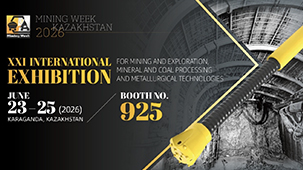
- SINOROCK Invites You to Mining Week Kazakhstan 2026
- Time:2026-06-08From:This Site
- Meet SINOROCK at Mining Week Kazakhstan 2026, Booth 925. Discover advanced self-drilling anchor systems and ground support solutions for underground mining, fractured ground, fault zones, and challenging geological conditions.
- View details
-
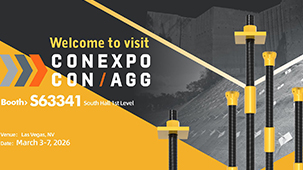
- Sinorock Invites You to Visit Us at CONEXPO-CON/AGG
- Time:2026-02-14From:This Site
- Sinorock Invites You to Explore Proven Self-Drilling Anchor Bolt Solutions at CONEXPO-CON/AGG –S63341.South Hall 1st Level
- View details
-
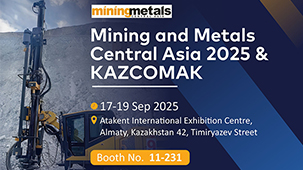
- SINOROCK to Showcase Innovative Mining Solutions at Mining and Metals Central Asia 2025
- Time:2025-09-09From:This Site
- We are pleased to share that SINOROCK will participate in the Mining and Metals Central Asia 2025, taking place from September 17 to 19 at the Atakent International Exhibition Centre in Almaty, Kazakhstan. You can find us at Booth 11-231.
- View details