Download

Common Types of Surrounding Rock Support in Tunnels
Time:2026-08-19From:sinorock View:
Tunnel engineering is an essential part of infrastructure construction. The safety and stability of tunnels directly affect both project quality and the safety of construction personnel. During tunnel excavation, geological conditions can vary significantly, requiring different types of support measures to ensure the stability of the surrounding rock. This article introduces the common types of surrounding rock support used in tunnel construction and their typical combinations.
Rock Mass Classification and Support Principles
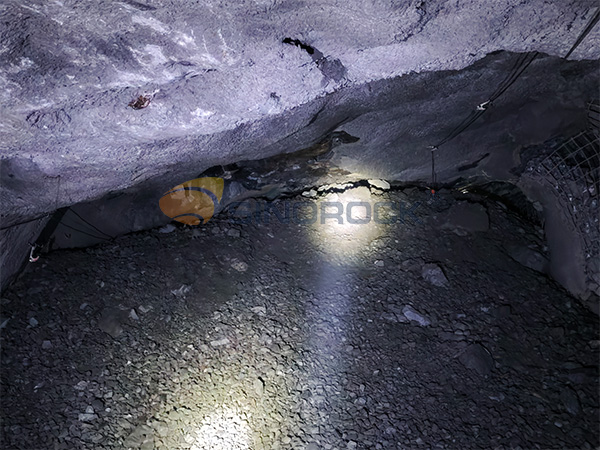
The quality of the surrounding rock directly affects tunnel support design. The commonly used RMR (Rock Mass Rating) system classifies rock masses into five grades:
· Grade 1 (Very Good): This type of rock requires only a few rock bolts or mesh for support, mainly to control the falling of small blocks.
· Grade 2 (Good): Support can consist of rock bolts plus shotcrete or a light steel frame, providing simple reinforcement for slightly fractured rock.
· Grade 3 (Good): Rock bolts combined with shotcrete are used to control overall displacement and prevent block collapse.
· Grade 4 (Poor): Support involves rock bolts, steel arches, and shotcrete, providing load-bearing capacity and surface protection while preventing collapse.
· Grade 5 (Very Poor): Support requires steel cable anchoring, steel arches, and high-strength shotcrete to enhance overall stability, suitable for very loose rock and high-stress conditions.
The selection of tunnel support should consider rock quality, geological conditions, excavation methods, and construction requirements. General principles include:
· The better the surrounding rock, the lighter the support; the poorer the rock, the heavier the support.
· Rock bolts combined with shotcrete are the most common basic support.
· Steel arches and cable anchors are suitable for complex, fractured, or deeply buried rock.
· Comprehensive support systems should balance safety, economy, and long-term stability.
1. Rock Bolt Support
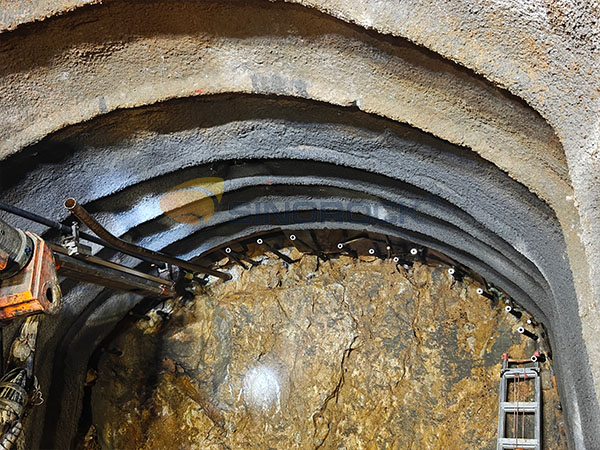
Rock bolt support is one of the most commonly used methods in tunnel engineering. It reinforces the surrounding rock and controls displacement. Rock bolts are typically made of steel bars or steel pipes, installed in drilled holes, and fixed with cement grout to anchor the rock mass. This method not only enhances the overall strength of the rock mass but also effectively limits the propagation of fractures and reduces rock damage.
Self-drilling anchors are a modern type of rock bolt that combines drilling and grouting into a single operation. They are particularly effective in fractured or soft rock and can be installed quickly and safely without pre-drilling, while also reducing equipment handling and operation time.
Features and Applications:
·Effective for medium or slightly fractured rock
·Limits local displacement and enhances overall stability
·Often combined with shotcrete or mesh for improved support
·Flexible layout in complex geological conditions, improving construction adaptability
2. Shotcrete Support
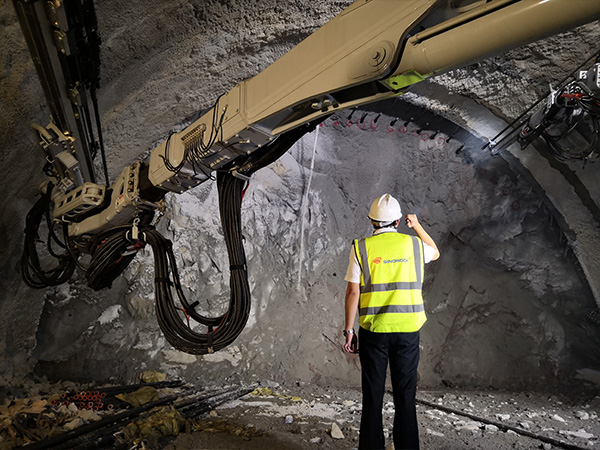
Shotcrete is concrete sprayed onto the rock surface using high-pressure equipment, forming a continuous protective layer that prevents rock falls and improves surface stability. It can quickly cover the rock face and fill cracks, reducing water erosion and rock weathering while accelerating safe subsequent construction.
Features and Applications:
·Rapid construction; protects the rock immediately after excavation
·Adapts well to irregular rock surfaces and distributes stress evenly
·Often used in combination with rock bolts or steel arches, especially in fractured or loose rock
·Concrete mix can be adjusted to enhance durability and crack resistance
3. Steel Arch Support
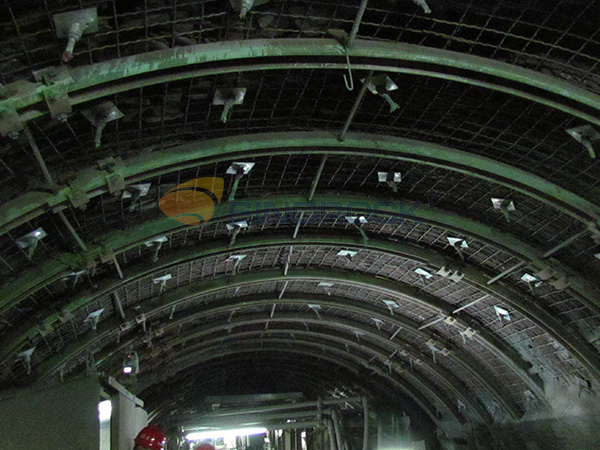
Steel arches are frame structures installed inside the tunnel cross-section. They can withstand significant rock pressure and protect workers and equipment. They provide primary load-bearing capacity in poor rock conditions while leaving enough space for auxiliary facilities and construction passageways.
Features and Applications:
·Suitable for loose, fractured, or high-stress rock
·Can be combined with shotcrete to form a "steel arch–shotcrete" support system
·Provides primary temporary stability during construction
·Reusable, offering good economic efficiency, suitable for temporary or multiple-use support
4. Cable Anchor Support
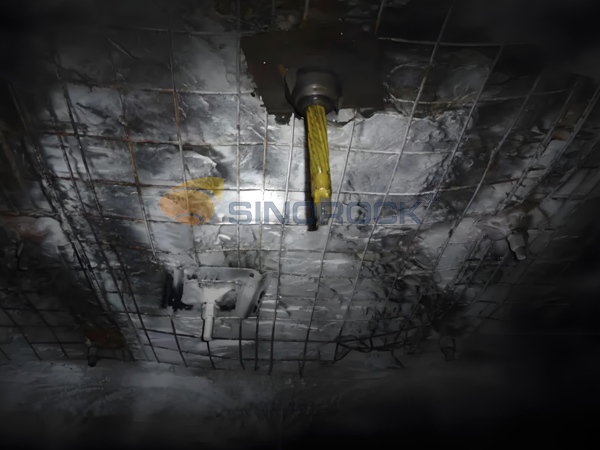
Cable anchors are long anchoring elements used to reinforce deep or large rock masses, commonly applied in large-section tunnels or poor rock conditions. They can integrate deep rock with surrounding more stable rock, significantly improving overall tunnel stability.
Features and Applications:
·Provides overall reinforcement for large rock masses
·Suitable for deep tunnels and high-stress environments
·Often used with steel arches and shotcrete for comprehensive support
·Effectively prevents large-scale collapses, enhancing long-term tunnel safety
5. Mesh and Lattice Girder Support
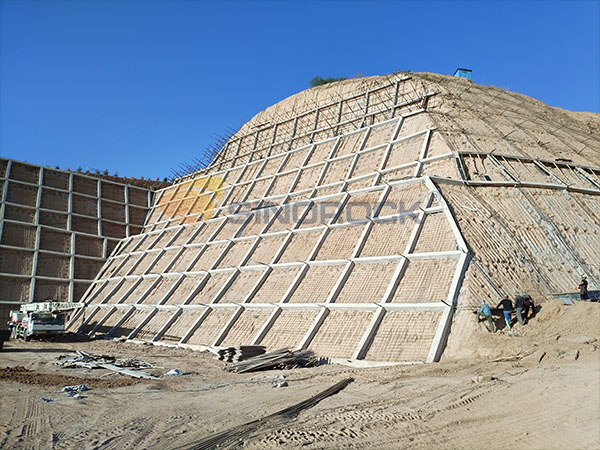
In the slope environment outside a tunnel portal, mesh and lattice girders are mainly used to prevent small-scale rockfalls or soil slides, protecting the construction area and surrounding roads. They work by securing loose rocks or soil layers on the slope and distributing local stress evenly across the support structure, thereby reducing the risk of slope collapse.
Features and Applications:
·Adaptable to irregular slope terrains; flexible and quick to install
·Can be combined with shotcrete to enhance surface stability of the slope
·Serves as an auxiliary support measure, especially suitable for fractured rock or loose slope material
·Can be adjusted during construction or maintenance to adapt to seasonal rainfall or freeze-thaw conditions
Conclusion
Supporting the surrounding rock is essential for tunnel safety and long-term stability. Self-drilling anchors provide a modern, efficient option for reinforcing fractured or soft rock. Selecting and combining appropriate support types based on rock quality ensures construction safety and enhances the tunnel’s durability. Additionally, specialized support such as mesh and lattice girders can also safeguard slopes outside tunnel portals, extending protection to both the tunnel and its surrounding environment.
latest news
-
- Self-Drilling Anchor Bolt Technical Parameters: Complete Specification Guide
- Time:2026-08-25From:This Site
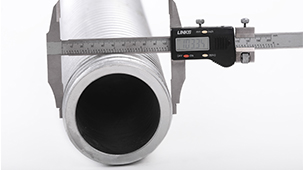
- Learn about self-drilling anchor bolt specifications, including diameter, wall thickness, tensile strength, yield strength, thread systems, load capacity, and corrosion protection options to select the right anchor solution.
- View details
-
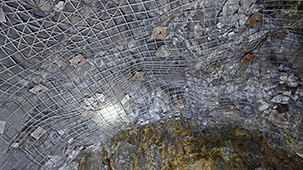
- Common Types of Surrounding Rock Support in Tunnels
- Time:2026-08-19From:This Site
- This article introduces common types of surrounding rock support in tunnels. It explains their features and applications to ensure tunnel stability.
- View details
-
- Why Do Self-Drilling Anchor Bolts Require a Dedicated Drilling Rig?
- Time:2026-08-08From:This Site
- Learn why self-drilling anchor bolts require dedicated drilling rigs. Explore how these rigs improve drilling efficiency, anchoring quality, and safety in tunnels, mines, slopes, and foundation engineering.
- View details
-
- Sinorock Conducts 2026 Safety Month Activities to Enhance Workplace Safety Management
- Time:2026-07-17From:This Site
- Sinorock launched the 2026 Safety Month campaign with safety training, hazard inspections, and emergency drills to strengthen workplace safety and risk prevention.
- View details
-
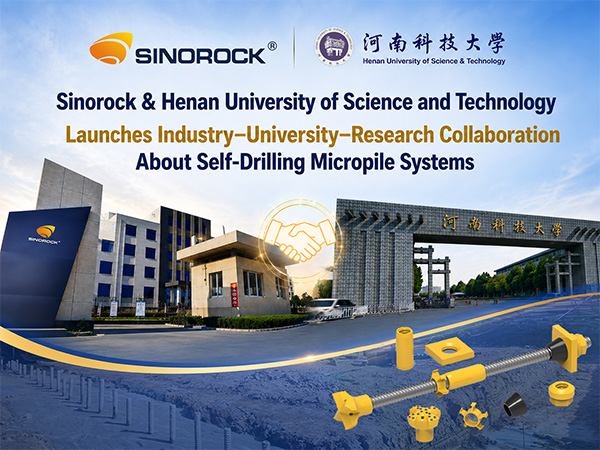
- Sinorock Launches Industry–University–Research Partnership with Henan University of Science and Technology on Self-Drilling Micropile Systems
- Time:2026-07-03From:This Site
- Sinorock has launched an industry–university–research partnership with Henan University of Science and Technology focusing on Self-Drilling Micropile Systems.
- View details
-
- CBAM Policy Interpretation: Sinorock Promotes the Low-Carbon Transformation of Self Drilling Rock Bolts
- Time:2026-06-25From:This Site
- CBAM policy interpretation for self drilling rock bolts, covering carbon footprint requirements, EU compliance rules, and Sinorock’s low-carbon manufacturing strategy.
- View details
-
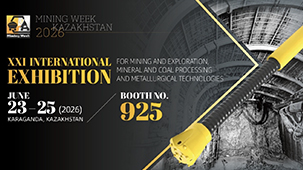
- SINOROCK Invites You to Mining Week Kazakhstan 2026
- Time:2026-06-08From:This Site
- Meet SINOROCK at Mining Week Kazakhstan 2026, Booth 925. Discover advanced self-drilling anchor systems and ground support solutions for underground mining, fractured ground, fault zones, and challenging geological conditions.
- View details
-
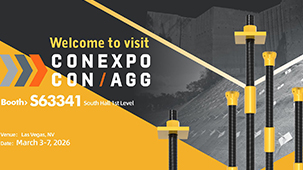
- Sinorock Invites You to Visit Us at CONEXPO-CON/AGG
- Time:2026-02-14From:This Site
- Sinorock Invites You to Explore Proven Self-Drilling Anchor Bolt Solutions at CONEXPO-CON/AGG –S63341.South Hall 1st Level
- View details
-
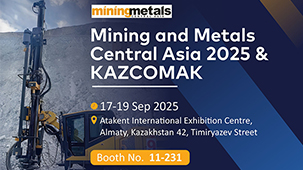
- SINOROCK to Showcase Innovative Mining Solutions at Mining and Metals Central Asia 2025
- Time:2025-09-09From:This Site
- We are pleased to share that SINOROCK will participate in the Mining and Metals Central Asia 2025, taking place from September 17 to 19 at the Atakent International Exhibition Centre in Almaty, Kazakhstan. You can find us at Booth 11-231.
- View details